

The Ultimate Guide to Heavy-duty Punch Bags and Stands in 2026
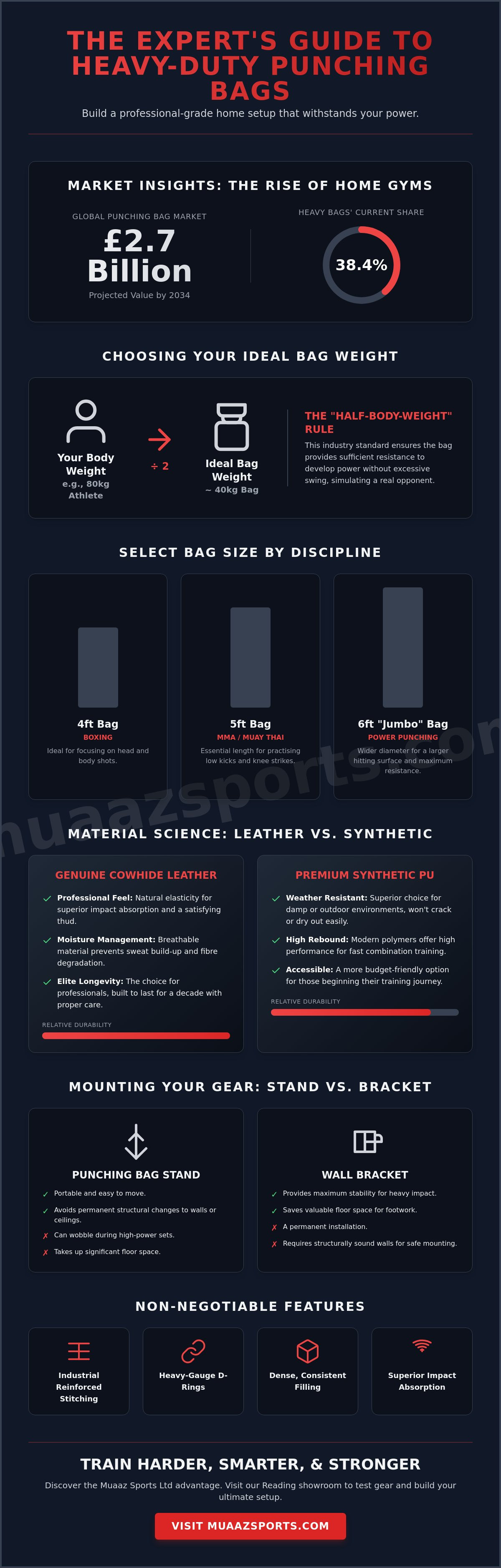
Did you know that heavy bags now account for 38.4% of the global market, which is projected to reach £2.7 billion by 2034? This massive growth highlights a clear trend: more athletes are building professional-grade setups at home. You've probably worried about a heavy duty punching bag causing ceiling damage or felt the annoyance of a stand that wobbles during a power set. It's a common headache for beginners, experts, and everyone in between who demands stability and durability from their gear.
You need equipment that stands up to your strongest hooks and fastest combinations. We'll help you master your home gym setup with this expert guide to choosing, mounting, and training with premium boxing equipment. You'll learn how to find the perfect weight-to-power ratio for skill development and select materials that won't split under pressure. We're covering the essential steps to ensure your station is secure so you can train harder, smarter, and stronger every single day.
Key Takeaways
- Understand the "half-body-weight" rule to select the perfect resistance level for your specific striking power and skill development.
- Compare the professional-grade longevity of genuine cowhide leather against the high-rebound performance of premium synthetic materials.
- Evaluate whether the portability of a punching bag stand or the permanence of a wall bracket best suits your training space and structural limits.
- Master high-impact drills on your heavy duty punching bag whilst maintaining elite safety standards with the correct protective equipment.
- Discover the Muaaz Sports Ltd advantage by visiting our Reading showroom to test gear and build a setup that lets you train harder, smarter, and stronger.
What Defines a Genuine Heavy Duty Punching Bag?
A true heavy duty punching bag is more than just a sack of fabric; it's a precision-engineered tool designed to absorb massive kinetic energy. In the professional world, "heavy duty" refers to bags weighing between 30kg and 60kg or more. These units are built to withstand the relentless force of elite strikers without tearing or losing shape. If your bag swings wildly after a single jab, it isn't heavy duty. It's a toy. You need a piece of equipment that offers enough resistance to develop "knockout power" whilst protecting your skeletal structure from unnecessary jar.
To choose the right resistance, follow the "half-body-weight" rule. This industry standard suggests that your bag should weigh approximately 50% of your total body mass. An 80kg athlete should train on a 40kg bag to ensure the equipment provides enough pushback to simulate a real opponent. For experienced strikers, density matters far more than height. A thick, dense bag allows you to dig into your punches, whereas a thin, tall bag might feel hollow and unresponsive. Look for industrial reinforced stitching and heavy-gauge D-rings. These components are the literal backbone of your setup, preventing the bag from splitting or falling during high-intensity rounds.
The Weight Classes of Boxing Bags
Selecting the right length depends entirely on your discipline. A 4ft bag is the traditional choice for boxers focusing on head and body shots. If you're training for MMA or Muay Thai, a 5ft or 6ft bag is essential for practicing low kicks and knee strikes. Many power punchers prefer "jumbo" bags, which feature a wider diameter. This extra girth provides a larger hitting surface and increased resistance, forcing you to use your core to move the weight. The internal filling also dictates the feel; rag-filled bags offer a consistent, professional strike surface, whilst sand-weighted bags provide a harder, bottom-heavy feel that challenges your hand conditioning.
Impact Absorption and Kinetic Energy
Your equipment must act as a shock absorber for your joints. A high-quality bag dissipates energy across its surface, reducing the risk of wrist, elbow, and shoulder injuries. Beginners should avoid bags that are rock-hard, as their connective tissues haven't yet adapted to the stress of heavy impact. Instead, choose a bag with a slight "give" that allows you to focus on technique without pain. The "swing" of the bag is also a vital training partner. A bag that moves slightly after a hit forces you to time your footwork and find your range. It teaches you to stay mobile, ensuring you train harder, smarter, and stronger with every session.
Material Science: Genuine Cowhide Leather vs Synthetic PU
Your choice of outer material dictates whether your kit lasts a single season or an entire decade. Professional boxers almost exclusively demand Genuine Cowhide Leather for their heavy duty punching bag because of its natural elasticity and superior moisture management. Unlike synthetic alternatives, leather "breathes." This organic property prevents the bag from becoming brittle whilst ensuring that sweat doesn't sit on the surface and degrade the fibres. There's also a distinct difference in "feel" upon impact. Leather provides a deep, satisfying thud that absorbs kinetic energy, whereas synthetic materials often have a sharper rebound that can be jarring on the knuckles during high-intensity rounds.
Tear resistance is where the material science truly matters. High-tensile stitching and reinforced seams are non-negotiable features for any serious striker. If the stitching fails, the most expensive leather in the world won't save your bag from splitting under the force of a 60kg fill. Premium leather gear also carries an undeniable aesthetic appeal; it's the mark of a specialist who values quality and the pursuit of excellence. It signals that you're serious about your craft and ready to put in the work required for elite performance.
The Durability of Genuine Cowhide
Genuine leather is an investment in your long-term success. In the United Kingdom, many athletes set up their stations in garages or sheds where humidity fluctuates. To maintain that professional-grade suppleness, you should apply a leather conditioner every six months. This prevents the hide from drying out in the cold or cracking during the summer. Muaaz Sports Ltd remains committed to providing this level of authenticity to Reading athletes and everyone in between, ensuring your foundation is built on top-notch materials that can survive the grit of daily training.
When to Choose Synthetic or PU Bags
High-quality PU (Polyurethane) has come a long way. By 2024, advanced synthetic polymers offer approximately 85% of the durability of leather whilst being more accessible for those just starting their journey. If you're training in a damp environment or an outdoor space, PU is often the superior choice. It's naturally water-resistant and won't rot if exposed to the British weather. For high-volume commercial gyms, reinforced vinyl is a popular hybrid because it's incredibly easy to sanitise between sessions. If you're looking for a reliable entry point, a premium synthetic heavy duty punching bag provides the resilience needed to help you train harder, smarter, and stronger.
Mounting Your Gear: Punching Bag Stand vs Wall Bracket
Choosing how to mount your heavy duty punching bag is a decision that impacts your home's structural integrity as much as your training rhythm. You must weigh the portability of a stand against the professional, permanent feel of a wall bracket. In the UK, where terraced housing and semi-detached homes are common, noise and vibration dampening become critical factors. A poorly mounted bag can send reverberations through shared walls, turning your midnight workout into a neighbourly dispute. Before you pick up a drill, assess your space. A hanging bag requires a 360-degree clearance of at least 1.5 metres to allow for movement, whilst a stand dictates a fixed footprint in your room.
Structural safety is paramount. Residential brickwork in many British homes isn't always designed to handle the lateral stress of a 60kg swinging mass. Amazon and other mass retailers often sell kits without explaining the risks to your masonry. Follow this checklist before committing to a wall mount:
- Wall Type: Ensure you're drilling into solid brick or concrete. Never mount a heavy bag to a stud wall without professional reinforcement.
- Mortar Integrity: Check for crumbling or "soft" mortar joints that could compromise bolt grip.
- Fixing Depth: Your wall must be at least 100mm thick to accommodate heavy-duty expansion bolts safely.
- Utility Check: Use a digital detector to locate hidden pipes or electrical cables before you start.
The Benefits of a Heavy Duty Punching Bag Stand
Stands are the ultimate solution for renters in Reading and across Berkshire who cannot drill into walls. Modern designs feature wide-base footprints and weight pegs where you can stack sandbags or plates to ensure total stability during power strikes. These units are often dual-purpose, incorporating a speed ball platform or a floor-to-ceiling bag attachment. This versatility allows you to build a complete combat station without a single hole in your masonry. It's the smartest way for beginners and experts to secure their gear whilst maintaining flexibility in their home gym layout.
Wall Brackets and Ceiling Hooks
If you have the space and the right walls, a bracket offers a professional look that maximises your floor area. This setup allows for unrestricted movement, which is essential for developing footwork and angles. Never skimp on hardware. Use M10 or M12 expansion bolts to ensure a secure fix that won't pull out under pressure. To protect your building and your joints, always include a heavy-duty spring attachment between the bracket and the bag chain. This small addition reduces the "shock" sent into the wall, dampening noise and extending the life of your equipment. Gear up with the right fixings to ensure you can train harder, smarter, and stronger without damaging your property.
Professional Drills for Heavy Bag Mastery
Once your station is secure, the real work begins. Owning a heavy duty punching bag is only the first step towards elite performance; the second is developing a technical mastery that translates to the ring. Muaaz Sports Ltd understands that true protection comes from a combination of top-notch gear and disciplined habits. You shouldn't just stand in front of the bag and unload. Instead, treat it as a moving, breathing opponent. Incorporate defensive slips and rolls into every offensive combination to ensure your chin is never a stationary target. Even during solo bag work, wearing a professional boxing head guard is a smart tactical choice. It maintains your spatial awareness and conditions you to the restricted visibility you'll face during live sparring sessions.
When you strike a heavy duty punching bag, the feedback should be firm and consistent. Avoid the trap of "pushing" your punches, which causes the bag to swing wildly. Instead, focus on the "snap" of the impact. Your hands should return to your face faster than they went out. This disciplined approach to training ensures you build the muscle memory required for high-stakes competition. By focusing on movement and precision, you'll ensure every session helps you train harder, smarter, and stronger.
Power and Conditioning Rounds
Organise your power rounds to push your cardiovascular limits. Start with the "Burnout" drill: end every 3-minute round with 30 seconds of non-stop, maximum-velocity power shots. This builds the lactic threshold necessary for the final rounds of a championship bout. Focus on single-shot precision between these bursts, ensuring each jab has a crisp "snap" against the cowhide. For those in the MMA or Muay Thai community, lower body integration is non-negotiable. Deliver high-volume kicking drills to condition your shins and develop explosive hip torque, turning your legs into heavy-duty weapons.
Speed and Rhythm Drills
Speed is about timing, not just fast hands. Use the "Pendulum" drill by moving with the natural swing of the bag. As the bag retreats, step in with a double-jab entry to measure the distance; as it returns, slip to the outside and counter with a lead-hand hook. This simulates a live opponent's movement and forces you to stay light on your feet. Maintain this rhythm through 3-minute intervals with a 1-minute active recovery, such as shadow boxing or light footwork. This structured approach ensures you build a warrior spirit that values quality and excellence.
Refine your striking and boost your power with gear designed for warriors. Shop our premium training equipment to complete your professional-grade setup today.
The Muaaz Sports Advantage for Reading Strikers
Muaaz Sports Ltd stands as the essential partner for athletes across Reading and the wider South East. We understand that a heavy duty punching bag is a significant investment in your athletic future. Our range is engineered to meet the specific demands of high-performance gyms, ensuring that every strike is met with professional-grade resistance. Unlike faceless online marketplaces, we invite you to visit our local Reading showroom. Here, beginners, experts, and everyone in between can test the density and surface texture of our gear firsthand. Feeling the impact of a Genuine Cowhide Leather bag before you purchase ensures you get the exact weight-to-power ratio your training requires.
We're deeply committed to the local combat community. Boxing clubs and martial arts academies throughout Berkshire can access our specialised trade accounts and wholesale benefits. This professional-minded approach allows local coaches to equip their fighters with top-notch gear at highly competitive rates. Our philosophy is simple: we provide the tools, and you provide the grit. Every piece of equipment we manufacture is built to help you train harder, smarter, and stronger. It's a promise of durability that allows you to push your limits without fear of equipment failure.
Custom Gear and Professional Protection
Mastering the heavy bag is only half the battle; you must also prioritise true protection. Pair your new heavy duty punching bag with our premium sparring gloves to ensure total hand safety during high-impact sessions. A complete combat setup isn't finished without essential safety gear like groin protectors and elasticated shin guards. For Reading martial arts schools looking to elevate their brand, we offer bespoke club logos and customisation options. This service allows local gyms to project a professional, elite image whilst providing their students with featured, reliable equipment that stands the test of time.
Expert Support and Local Delivery
Choosing a UK-based specialist like Muaaz Sports Ltd guarantees a level of after-sales care that international retailers simply can't match. We're part of your community, and we value the trust you place in our brand. Because we're local, we offer fast delivery options across Berkshire and the South East, getting your gear to your door without the long wait times. Whether you're setting up a garage gym in Tilehurst or a professional studio in the town centre, we have the inventory and expertise to support your journey. Don't settle for second-best when your safety and progress are on the line. Equip your home gym with Muaaz Sports Ltd today and start your transformation into a more disciplined, powerful striker.
Build Your Professional Foundation Today
You now have the blueprint to master your home gym setup. From understanding how the "half-body-weight" rule dictates your resistance to choosing between the permanence of a wall bracket or the flexibility of a stand, you're ready to train with purpose. Material science isn't just about looks; our Genuine Cowhide Leather construction is built to absorb the kinetic energy of elite power strikers whilst protecting your joints from unnecessary jar.
Investing in a premium heavy duty punching bag means joining the ranks of professional Reading boxing clubs who rely on Muaaz Sports for true protection. Our gear is specifically engineered to help beginners, experts, and everyone in between train harder, smarter, and stronger every single day. Stop compromising on quality and start building a training environment that matches your dedication to the sport. Your peak performance requires equipment that won't split or wobble when the intensity rises.
Shop our Professional Heavy Duty Punching Bags to secure your professional-grade equipment now. Gear up, stay disciplined, and unleash your full potential.
Frequently Asked Questions
Is a 4ft or 5ft heavy bag better for home training?
Your choice depends entirely on your training discipline. A 4ft bag is the standard for boxing as it provides ample surface area for head and body shots whilst fitting comfortably in standard UK rooms with lower ceilings. If you're practicing Muay Thai or MMA, a 5ft bag is essential because it allows for low kicks and knee strikes that a shorter bag cannot accommodate. Most athletes in Reading find the 4ft version more versatile for general fitness and power development.
Can I hang a heavy punching bag from a standard garage beam?
You can only hang a bag if the beam is a load-bearing, structural member. Standard 4x2 ceiling joists in many residential garages aren't designed to handle the 50kg dead weight plus the lateral force of a swinging heavy duty punching bag. Always use a heavy-duty spring to dampen vibrations and prevent the bolts from vibrating loose. If you're unsure about your beam's integrity, a free-standing stand is a much safer alternative for your property.
How much weight should I put on the base of my punching bag stand?
Load the base with at least 60kg of counterweight to ensure it stays grounded during power rounds. Most professional stands feature weight pegs designed for standard 20kg plates; use at least three to prevent the frame from lifting. If you're a heavyweight striker delivering maximum force, increasing this to 100kg will provide the elite-level stability required to train harder, smarter, and stronger without the equipment "walking" across the floor.
Do I need to wear boxing gloves when using a heavy bag?
You must always wear boxing gloves and hand wraps to protect the small bones in your hands. Striking a dense 40kg bag without protection will lead to metacarpal fractures and wrist strain, stalling your progress. Professional-grade gloves provide the "true protection" needed to absorb kinetic energy and allow you to focus on your technique. This discipline ensures you build a foundation of success whilst maintaining your physical well-being for the long term.
What is the best way to clean a leather punching bag?
Wipe the surface with a slightly damp microfibre cloth after every session to remove sweat and salt. Every six months, apply a premium leather conditioner to keep the Genuine Cowhide Leather supple and prevent it from becoming brittle in cold UK garages. Avoid using bleach or harsh chemical sprays. These substances strip the natural oils from the hide, which can lead to the material cracking or splitting under the pressure of high-impact hooks.
Will a heavy bag stand move around during a workout?
A stand will move slightly during high-intensity sessions if it isn't properly anchored or weighted. To stop this, place the unit on a high-density rubber mat to increase friction and absorb shock. This setup protects your floor whilst keeping the frame secure. Even with 60kg of plates, the frame might shift over time, so check the positioning of your heavy duty punching bag station every few rounds to maintain your training rhythm.
How often should I replace the filling in my bag?
You should inspect and redistribute the filling every 12 months to prevent "hard spots" from forming at the base. Over time, gravity causes the internal materials to settle, which can make the bottom of the bag feel like concrete and increase the risk of injury. Unzip the top and pack in new rags or foam offcuts to maintain a consistent, professional-grade striking surface. This simple maintenance task extends the life of your gear by several years.
What is the difference between a heavy bag and a wrecking ball?
The primary difference lies in the shape and the specific strikes they are designed to receive. A standard heavy bag is a long cylinder meant for straight punches, hooks, and kicks. A wrecking ball is a dense sphere that allows you to practice uppercuts and angled strikes that are difficult to land on a flat surface. Professional gyms often use a mix of both to ensure their fighters develop a versatile and unpredictable offensive arsenal.