

The Ultimate Leather Weightlifting Belt Guide: Lift Stronger, Smarter, Harder
That £20 nylon strap you're wearing isn't just slipping; it's actively sabotaging your chances of hitting a new 180kg squat. You've likely felt that frustrating wobble during a heavy set or the nagging lower back discomfort that follows a session with subpar gear. It's time to stop settling for equipment that stretches under pressure. Choosing the right leather weightlifting belt is the single most important investment you'll make for your long-term strength and spinal health.
We agree that nothing beats the rock-solid stability of professional-grade gear when you're staring down a heavy barbell. This guide promises to help you navigate the technical specifications needed to dominate your personal bests whilst staying injury-free. You'll discover how to choose between lever and prong buckles, understand the March 2026 IPF regulation updates regarding 13mm thickness, and learn why genuine cowhide leather is the only material that truly moulds to your body. Gear up, stay protected, and prepare to train harder, smarter, and stronger with a belt built for champions.
Key Takeaways
- Learn why a professional-grade leather weightlifting belt provides the rigid intra-abdominal pressure needed to protect your spine during heavy compound lifts.
- Discover the durability of Genuine Cowhide Leather and how to distinguish between single-ply and multi-ply construction for maximum resilience.
- Compare lever and prong fastening systems to find the perfect balance between "set and forget" convenience and precise adjustment.
- Master the essential "rolling" technique to break in your premium gear quickly without damaging the structural integrity of the leather.
- Understand how to Train Harder, Smarter, Stronger by choosing equipment designed by experts who value elite performance and true protection.
Why a Leather Weightlifting Belt is Essential for Peak Performance
Stop listening to the gym floor myths that claim using a weightlifting belt is a shortcut or a sign of a weak core. In reality, a professional leather weightlifting belt is a precision tool designed to unlock your body's true potential. It isn't a back brace for the injured; it's a rigid external wall that allows your midsection to generate massive amounts of intra-abdominal pressure. Whilst a cheap nylon strap might feel comfortable, it lacks the structural integrity required to support a 140kg squat or a 200kg deadlift. Genuine leather offers a level of durability that synthetic materials simply cannot match. A high-quality belt from Muaaz Sports Ltd can easily last a decade of heavy abuse, whereas nylon begins to fray and lose its tension within months. Gear up with gear that lasts as long as your ambition.
The Science of Intra-Abdominal Pressure
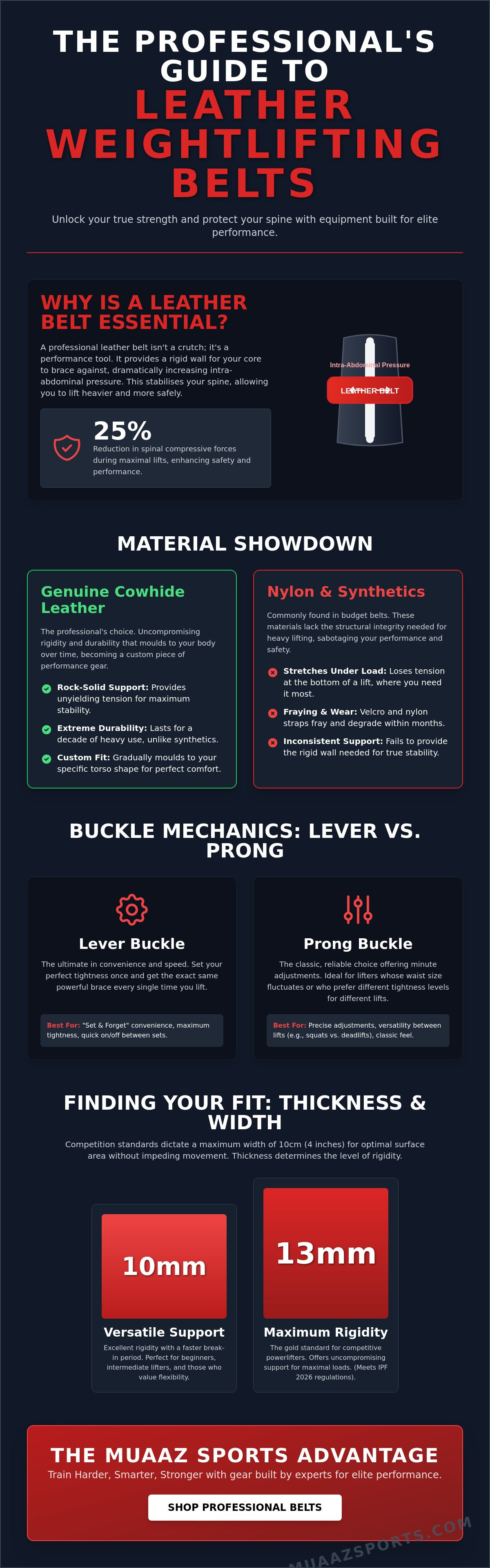
Think of your torso as a pressurised cylinder. When you take a deep breath and brace, your abdominal muscles push outwards. A leather belt provides a rock-solid surface for those muscles to fight against. This creates a surge in intra-abdominal pressure that stabilises your spine from the inside out. Studies indicate this mechanism can reduce spinal compressive forces by up to 25% during maximal effort lifts. This isn't just about safety. Increased stability leads to faster bar speed and more confidence under the iron. You'll lift heavier, move faster, and recover better. It's the difference between a shaky rep and a dominant one.
Leather vs Synthetic: Making the Professional Choice
Serious athletes in Reading don't compromise on their gear. They choose leather because it provides consistent, unyielding tension that Velcro belts can't replicate. A leather weightlifting belt made from genuine cowhide possesses a unique property: it moulds to your specific torso shape over time. Whilst it starts stiff and intimidating, it eventually becomes a custom-fit piece of armour. Nylon belts are too flexible; they stretch when you need them to hold firm. For heavy compound movements, you need the uncompromising rigidity of leather to ensure your power isn't leaked through a soft, shifting midsection. Trust Muaaz Sports Ltd for the material that has been the gold standard for decades. Train Harder, Smarter, Stronger.
Decoding Material Quality: Why Genuine Cowhide Leather Matters
Don't be fooled by generic "leather" labels found on mass-market retail sites. Most budget options use bonded leather, which is essentially scraps of hide glued together and coated in plastic. These belts crack, stretch, and fail exactly when you need them to hold firm. Muaaz Sports Ltd refuses to compromise. We use Genuine Cowhide Leather because it offers the elite resilience required for high-intensity training. This premium material doesn't just survive under a 200kg load; it thrives. It's a technical choice that directly impacts your output. In fact, peer-reviewed research confirms that a rigid belt improves squat performance by increasing both bar velocity and the number of repetitions you can grind out before failure. You're investing in a performance tool, not just an accessory.
The construction of your leather weightlifting belt determines its lifespan. Single-ply belts use one thick, continuous piece of hide, offering a more natural break-in period. Multi-ply belts involve several layers of leather stitched together. Whilst multi-ply construction is common for achieving a 13mm thickness, it requires industrial-grade heavy-duty stitching to prevent the layers from delaminating. Our tanning process ensures the leather remains supple enough to mould to your torso whilst maintaining the structural rigidity needed to protect your spine. If you're ready to upgrade from a fraying nylon strap, check out our professional-grade leather weightlifting belts designed for the Reading lifting community.
Thickness and Width Standards
Precision matters in the power rack. According to the March 2026 IPF technical updates, a competition-legal belt must not exceed 10cm (4 inches) in width. This standard provides the maximum surface area for your abdominals to push against without digging into your ribs or hips. When choosing your thickness, consider your goals:
- 10mm: The versatile choice. It offers excellent support with a shorter break-in period, making it ideal for beginners and intermediate lifters.
- 13mm: The maximum allowed thickness. This is the gold standard for competitive powerlifters who need the most rigid wall possible for maximal effort squats and deadlifts.
- Straight vs Tapered: Straight 4-inch belts are superior for powerlifting. Tapered belts, which are thinner at the front, are better suited for Olympic lifting where mobility is more critical than absolute rigidity.
Stitching and Finish: The Mark of a Premium Belt
Look closely at the edges. A premium belt features burnished, sealed edges and reinforced double-stitching. This prevents the leather fibres from fraying over years of sweat and friction. We also include a high-grip suede inner lining. This isn't just for comfort; it's a safety feature that stops the belt from shifting or sliding mid-lift. Avoid belts with single-row stitching or genuine leather that feels like cardboard. True quality feels heavy, smells of authentic hide, and stands ready for battle. Train Harder, Smarter, Stronger.
Buckle Mechanics: Choosing Between Lever and Prong Systems
Your leather weightlifting belt is only as strong as its weakest link. For most athletes, that link is the buckle hardware. You wouldn't trust a cheap plastic clip to hold a 200kg load, so why settle for anything less than industrial-grade steel? Choosing between a lever and a prong system isn't just about aesthetics; it's about how you train and how quickly you need to engage your brace. Muaaz Sports Ltd ensures that every component, from the hide to the chrome-plated steel, is built for the platform. High-performance gym belts rely on heavy-duty hardware to ensure the fastening never shears under the massive internal pressure you generate during a lift. This hardware is the engine that keeps your spine secure whilst you push for a new personal best.
Whilst the primary goal of a belt is to increase performance, it must also align with safe lifting principles to ensure you aren't placing undue stress on your body through equipment failure. According to the March 1, 2026, IPF Technical Rulebook, both lever and prong systems are competition-legal, provided they meet the specific width and thickness requirements discussed earlier. Reliability is paramount because a buckle failure mid-squat can lead to a catastrophic loss of tension. Muaaz Sports Ltd provides gear that won't quit before you do. Gear up, stay focused, and Train Harder, Smarter, Stronger.
The Lever Belt: Speed and Maximum Tightness
Lever buckles are the gold standard for competitive powerlifters who demand a "set and forget" experience. The mechanical advantage of the lever allows you to snap the belt significantly tighter than you could ever pull a prong by hand. This creates an uncompromisingly rigid wall for your abdominals. However, this tightness comes with a trade-off. You'll need a screwdriver to adjust the lever position if your waist size changes due to bloating or shifting from a thick hoodie to a t-shirt. It's the ultimate choice for dedicated squat and deadlift sessions where maximum compression is the only priority.
The Prong Belt: Traditional Reliability
Single-prong belts are the workhorses of the Reading lifting community. They offer instant adjustability without the need for tools. This is a massive benefit if you prefer a bone-crushing fit for squats but a slightly looser notch for deadlifts to allow for a better starting position. Don't be tempted by double-prong belts; they're notoriously difficult to get on and off and don't provide any extra safety over a high-quality single prong. If you're a bodybuilder or a general strength athlete who moves quickly between different exercises, the prong system offers the versatility you need to stay focused on the work.
Maintenance and the Break-In: How to Master Your New Belt
Don't be surprised when your new leather weightlifting belt arrives feeling stiff, unyielding, and perhaps a bit uncomfortable. This is the hallmark of professional-grade gear. A belt that's soft out of the box is a belt that will eventually stretch and fail under the pressure of a 180kg squat. Premium Genuine Cowhide Leather requires a dedicated breaking-in period to transition from a rigid piece of equipment into a custom-fit tool that contours perfectly to your unique torso shape. Expect this process to take roughly 10 to 15 heavy training sessions before the hide truly begins to cooperate with your movements. Embrace the stiffness; it's the physical manifestation of the support that will help you smash your next personal best.
Softening Your Belt Without Losing Support
Mastery over your equipment starts with the rolling technique. You need to soften the fibres without compromising the structural core that provides your protection. Follow these steps to increase suppleness safely:
- Lay the belt flat on a clean, dry surface.
- Firmly roll the leather from the buckle end toward the tip, creating a tight cylinder.
- Unroll it and repeat the process in the opposite direction.
- Gently work the leather with your hands to loosen the grain whilst maintaining the essential thickness.
Never use harsh chemicals, industrial oils, or microwave heat to speed up this process. These methods destroy the natural proteins in the hide, leading to premature cracking or permanent stretching. Patience is the price of elite performance. If you're ready to invest in gear that actually rewards your hard work, shop our range of professional gym belts and start the journey toward a perfect fit.
Long-Term Leather Care
Sweat, chalk, and friction are the primary enemies of longevity. Over time, salt build-up from intense sessions in Reading's commercial gyms or cold garage setups can dry out the leather. Wipe your belt down with a damp cloth at least once a month to remove residue and prevent the material from becoming brittle. If you train in a damp environment, pay close attention to the steel hardware; a tiny drop of lubricant on the buckle pins every six months will prevent rust and ensure the mechanism never sticks mid-set. Apply a specialized leather conditioner twice a year to keep the fibres resilient and prevent the surface from fraying. Consistent leather maintenance is the foundation of a lifetime of safety and performance. Gear up, stay disciplined, and Train Harder, Smarter, Stronger.
The Muaaz Sports Advantage: Built for Reading Athletes
Choosing a leather weightlifting belt is a decision that defines your commitment to the iron. Muaaz Sports Ltd isn't just another faceless online retailer; we're your local Reading-based specialist dedicated to the grit and dedication of the UK lifting community. We understand that whether you're a beginner hitting your first 60kg squat or an expert prepping for a regional powerlifting meet, your gear must be an extension of your body. Our belts are engineered with one goal in mind: to provide the essential foundation upon which you build your success. We bridge the gap between elite performance and accessibility, ensuring that everyone in between has the tools to thrive.
Every product we release is forged under our core philosophy: Train Harder, Smarter, Stronger. This isn't just a slogan; it's a technical requirement. By using only Genuine Cowhide Leather, we ensure that our weightlifting gym belts provide the uncompromising rigidity needed for true protection. Unlike cheap alternatives that fray or lose their shape, our leather actually adapts to your torso over time. It's a professional-grade seal of authenticity that gives you the confidence to strive for peak performance in every session. You aren't just buying a belt; you're securing a partner for your most intense training days.
Local Support for South East Lifters
Operating from our Reading HQ, we provide the Berkshire lifting community with more than just equipment. We offer fast UK shipping and a level of professional assurance that only a local specialist can provide. We take pride in supporting the gym culture amongst the athletes of the South East. If you're unsure about sizing or buckle types, you can even visit our Portman Road centre for expert gear advice. We're here to ensure every athlete has access to top-notch protection that meets the high standards of modern strength training.
Gear Up for Your Next PB
Investing in a Muaaz Sports Ltd weightlifting belt is a strategic move for your long-term athletic development. It's a lifetime tool that grows with you as your numbers on the bar increase. To round out your training, consider our complementary gear like our Muaaz Sports Ltd speed skipping ropes to boost your conditioning and footwork between heavy days. Don't let subpar equipment be the bottleneck in your progress. Shop the Muaaz Sports Ltd leather weightlifting belt collection now and join the ranks of athletes who refuse to settle for anything less than excellence. It's time to gear up and dominate your personal bests.
Master the Iron with Elite Protection
Your journey toward a new personal best requires more than just grit; it demands equipment that won't fail when the load gets heavy. You've learned how the right leather weightlifting belt acts as a rigid wall for intra-abdominal pressure and why the break-in period is a necessary ritual for a custom fit. Whether you choose the rapid engagement of a lever or the versatile adjustability of a single-prong system, your focus remains the same: total spinal stability and maximum power output.
At Muaaz Sports, we build gear for the Berkshire lifting community that meets rigorous UK strength standards. Our belts feature premium Genuine Cowhide Leather construction, providing a professional-grade foundation for beginners, experts, and everyone in between across South East England. Don't let a flimsy nylon strap be the reason you plateau. It's time to invest in a tool that works as hard as you do. Upgrade your lifting game with a Muaaz Genuine Leather Weightlifting Belt and experience true protection. Gear up, stay focused, and continue to Train Harder, Smarter, Stronger. The platform is waiting for you.
Frequently Asked Questions
How tight should my leather weightlifting belt be for squats?
Your belt should be tight enough to provide a solid wall but loose enough to allow a full 360-degree breath into your abdomen. A common rule of thumb is being able to fit one finger between the belt and your stomach whilst braced. If you can't breathe deeply, it's too tight; if it slides during your set, it's too loose. Achieving this balance ensures maximum intra-abdominal pressure for your heaviest squats.
Can I use a leather weightlifting belt for every exercise in the gym?
Save your belt for heavy compound movements like squats, deadlifts, and overhead presses where spinal stability is the priority. Using a leather weightlifting belt for every isolation exercise, such as bicep curls or tricep extensions, is unnecessary and may hinder your natural core development. Wear it when the load exceeds 80% of your maximum effort to ensure true protection during your most demanding sets. Gear up only when the intensity demands it.
What is the difference between a 10mm and 13mm leather belt?
The primary difference lies in rigidity and the length of the break-in period. A 10mm belt offers excellent support whilst remaining flexible enough for general strength training and beginners. A 13mm belt is the maximum thickness allowed by the March 2026 IPF standards and provides an uncompromisingly stiff wall for competitive powerlifters. Choose 10mm for versatility and 13mm if your sole focus is moving the absolute maximum weight possible on the platform.
Is a lever belt better than a prong belt for beginners?
Prong belts are often better for beginners because they offer instant adjustability as your body composition and lifting attire change. A lever belt requires a screwdriver to adjust the fit, which can be frustrating if you're still learning how to brace correctly. Beginners benefit from the ability to test different tightness levels across various exercises without needing tools. Start with a single-prong to master your technique before moving to a lever system.
How do I measure my waist correctly for a weightlifting belt?
Measure around your midsection at the level of your navel, not your trouser waistline. Use a flexible measuring tape and pull it snug whilst in a relaxed state. Your lifting belt sits much higher than your jeans, so using your trouser size will almost certainly result in a belt that is too small. Accurate measurements are the foundation of a perfect fit, ensuring your gear supports you exactly where it matters most.
Why does my new leather belt leave bruises on my ribs?
Bruising is a common side effect of the break-in period for high-quality, stiff leather. This happens because the material hasn't yet moulded to your unique torso shape and may be digging into your ribs or hip bones during deep squats. Ensure the belt is positioned centrally between your ribs and hips. As the leather fibres soften over roughly 15 sessions, the bruising will subside, leaving you with a custom-fit piece of armour.
How long does a genuine cowhide leather belt typically last?
A belt crafted from Genuine Cowhide Leather is a lifetime investment that can easily last 10 to 15 years with basic maintenance. Unlike synthetic alternatives that degrade and fray, genuine hide becomes more resilient and comfortable over time. Keep it clean from sweat and use a leather conditioner twice a year to prevent cracking. When you buy quality, you only buy once. Train Harder, Smarter, Stronger with gear built for longevity.
Are Muaaz Sports belts approved for powerlifting competitions in the UK?
Yes, our belts are designed to meet the technical specifications required for UK powerlifting competitions. As of the March 1, 2026, rule updates, competition-legal belts must not exceed 10cm in width or 13mm in thickness. Our professional-grade leather weightlifting belt adheres to these strict dimensions, making it suitable for both local Reading meets and national championships. We provide the elite equipment needed for athletes to compete with confidence and stay within federation regulations.